Koala Action Group Qld Inc

A Voice For Koalas in the Redlands

  • Home
  • About Us
  • Contact Us

k

  • Report a healthy koala sighting
  • Report sick or injured koalas to 3299 1032 or A/H 3833 4031

Coming Up...
  • Tree Plantings
  • Bushwalks and Tree Id.
  • Meetings
  • Community Events
  • Home
  • News
  • Newsletters
  • Phone In Survey
  • Property Advice
  • Koalas in the Redlands
  • Reports and Submissions
  • About Us
  • Become a Member
  • Upcoming Events

Koala Facts: Koalas in the Redlands

koala letter

Redlands forms a large part of the Koala Coast and is now home to an estimated 1500 koalas (2008), many living in suburban yards, local parks, schools and remnant bushland areas

The history of koalas in Australia has not only been littered with natural disasters such as bushfires, but also millions were slaughtered by humans for the fur trade, almost leading to their extinction.  At right is a letter dated 20/7/ 1927 from the Redlands Branch of the Local Producers Association calling "for destruction of native bears to be stopped".

Redlands forms a large part of the Koala Coast and is now home to an estimated 1500 koalas (2008), many living in suburban yards, local parks, schools and remnant bushland areas.  Previous surveys in 1996 and in 2005-06 estimated koala numbers at 4050 and 3000 respectively.

The greatest threat to koalas is loss of habitat. Fewer trees means extended time is spent on the ground where they are vulnerable to traffic and dogs. Read here about the "Seven Misconceptions About Dogs and Koalas"

Chlamydia, considered to be a stress related disease due to habitat loss, is a major killer of koalas. One of its forms, conjunctivitis, affects the eyes and can lead to blindness. Early treatment has a high success rate. Another form of chlamydia, cystitis, affects the urinary tract and is characterised by a wet bottom or "dirty tail". This more sinister form is generally fatal unless treated very early.

To view the EPA Survey Report in its entirety click here EPA and click on 2008 Koala Population Koala Coast.

What food do Koalas Eat in the Redlands?

Healthy trees look best and support greater numbers of koalas. A little time spent selecting the most appropriate species for your situation will help achieve these results.

Trees grown from seed collected from local varieties are best because they help preserve the original pattern of vegetation and do not cause detrimental changes in the offspring of bushland trees.

Heights given here are approximate and are only observed from very mature trees in a forest situation.

Trees grown in full sun are often lower. Height can be reduced by choosing for the position and pruning when young.

  • Eucalyptus tereticornis (Queensland blue gum) The classic gum tree with smooth bark, often in interesting patterns and colours. It prefers the deep alluvial soils found on the coast and along creeks and gullies. A koala favourite. (40 metres)
  • Eucalyptus microcorys (Tallowwood) Attractive dense dark green leaves. A good shade tree but does eventually grow tall (40 metres). Highly sought after by koalas as it seems to "balance" a diet of scribbly gum. Found in most parts of the Redlands.
  • Eucalyptus seeana (Narrow-leaved red gum) One of the smaller local food trees (15 metres). Takes well to pruning for a compact well-shaped attractive tree with weeping foliage. Found in most areas of the Redlands - tolerates poorly drained shallow soils.
  • Eucalyptus resinifera (Red stringybark) Highly favoured by koalas and will grow on shallow, stony soils that are well drained (30 metres).
  • Eucalyptus racemosa (Scribbly gum) Often used by koalas in the Redlands, especially in conjunction with the Tallowwood. (25 metres).
  • Eucalyptus propinqua (Small-fruited grey gum) Has attractive orange patches of bark when first shed. Will grow on shallow, stony soils if wet enough (30 metres).  Eucalyptus robusta (Swamp mahogany) Ideal for damp sites close to shoreline (30 metres).
  • Eucalyptus nicholii (Willow peppermint) Non-local (native to the New England Tableland) but worth growing in situations suitable for a small tree (7 metres). Koalas enjoy the fragrant leaf but the tree can be short lived.

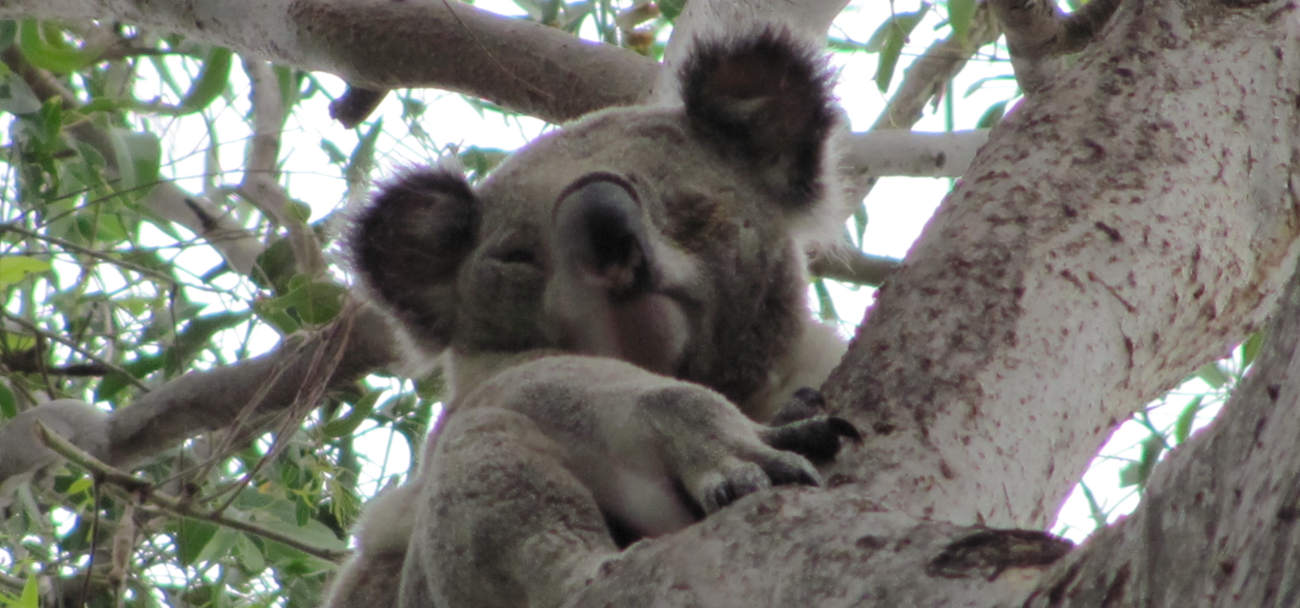
The koala is a mainly nocturnal, arboreal marsupial which lives almost entirely on eucalypt leaves, one of its favourite being the Queensland Blue Gum (Eucalyptus tereticornis). An adult koala may eat up to a kilogram of leaves per day. Sufficient moisture is usually obtained from the leaves but koalas will drink from streams or water containers if thirsty due to drought conditions or illness.

The koala is specially adapted to climbing trees having a powerful grip, sharp claws on its three fingers and two opposable thumbs and a granular palm on each hand. Its feet consist of a clawless thumb like digit and four other clawed digits, the first and second of which are partly fused together to form a comb for grooming.



How Does Development Affect Koalas?


An example of a 'koala sensitive' housing development

Location: Ney Road Capalaba, Koala Park Estate

Area: 69 hectare bushland site

25% of the land was developed in a koala sensitive manner (large lots)

25% of the land was kept for conservation (This is better than the average housing estate - only 10% is required to be set aside as public land.)

Koala Research: the koalas were monitored by Queensland Parks and Wildlife Service (QPWS) scientists prior to, during and after development.

QPWS Research Revealed…

1995 - Prior To Development
2004 - Post Development
70 koalas on site 15 koalas on site
5% with clinical signs of disease 25% with clinical signs of disease
90% of females with young Less than 30% of females with young

Where did the koalas go?

38% of the koalas left the area in the early stages of clearing.

Around half of these koalas were killed by cars and dogs while on the move.

The small population remaining on site are now faced with a smaller gene pool and the possibility of inbreeding.

This research proves without doubt that development, including 'koala sensitive' estates has a devastating impact on koala populations in the short and long term.

"I Used To See Koalas All The Time … …but not as many in recent years". Research has proven Redland's urban koalas are in rapid decline, resulting in their listing as a 'vulnerable' species in this region.

 
KOALAS - Slow life in the Fast lane

Koalas - Slow Life in the Fast Lane - produced for the ABC - reveals the amazing social dynamics of koalas as seen through the eyes of the scientists tracking the wellbeing of the koalas as their bush homes are encroached by urbanization.

For the first time, an in-depth nature documentary where scientists interpret the behaviour of animals is being made about koalas showing the conflicts and dangers that occur within the usually hidden world of a koala colony. The new science provides a window into how “urbanization” is impacting on the intricate workings of a koala colony and so gives an opportunity to illustrate how this iconic Australian animal is coping in today’s world and interacting in our neighbourhoods. A documentary team from Wild Fury and Mindful Media productions worked with the Koala Action Group during its recent annual Koala Survey to obtain footage.

The production team is also asking residents to record any koala sightings on their mobile phones or digital cameras - and good still images are also most welcome. The type of koala behaviour they are seeking is where koalas are walking on the ground, climbing up or down a tree, climbing or walking along fences, etc.

The documentary's production manager, Isabel Perez wants residents to continue to record koala sightings up to mid December at which point the selected clips will be incorporated in the film during the post production phase. If you have suitable clips of koala sightings please call Isabel on 0407 262414, who will arrange for their transfer. The best clips will end up in the documentary which broadcasts on the ABC later this year, as well as in North America and other places around the world.

What is coming up next...

Friday March 2nd
KAG general meeting
at the Redlands IndigiScapes Centre, Capalaba.

(PLEASE NOTE: this date was incorrectly advertised in the previous newsletter.)
KAG meetings in 2012 will be quarterly.

Sunday March 4th
Clean-up Australia Day

at the newly named Bob and Delphine Conservation Area at Victoria Pt.

Tree Planting
Planning underway for 2012
First planting in April - date to be advised

Visit us on Facebook

Home | About Us | Contact Us | Tree Plantings | Bushwalks and Tree Identification | Meetings | Community Events
Newsletters | News | Phone In Survey | Property Advice | Koalas in the Redlands | Reports and Submissions | Login / Logout

Copyright © 2011 Koala Action Group Qld Inc.
All Rights Reserved.

Proudly supported by JMWD.